
Vitality
Intelligence - VIT
A framework for understanding and supporting human readiness in complex environments.
Readiness is not a trait. It is a state.
The Framework
How VIT Thinks
Vitality Intelligence is built on a simple premise:
human readiness is not fixed — it emerges moment by moment.
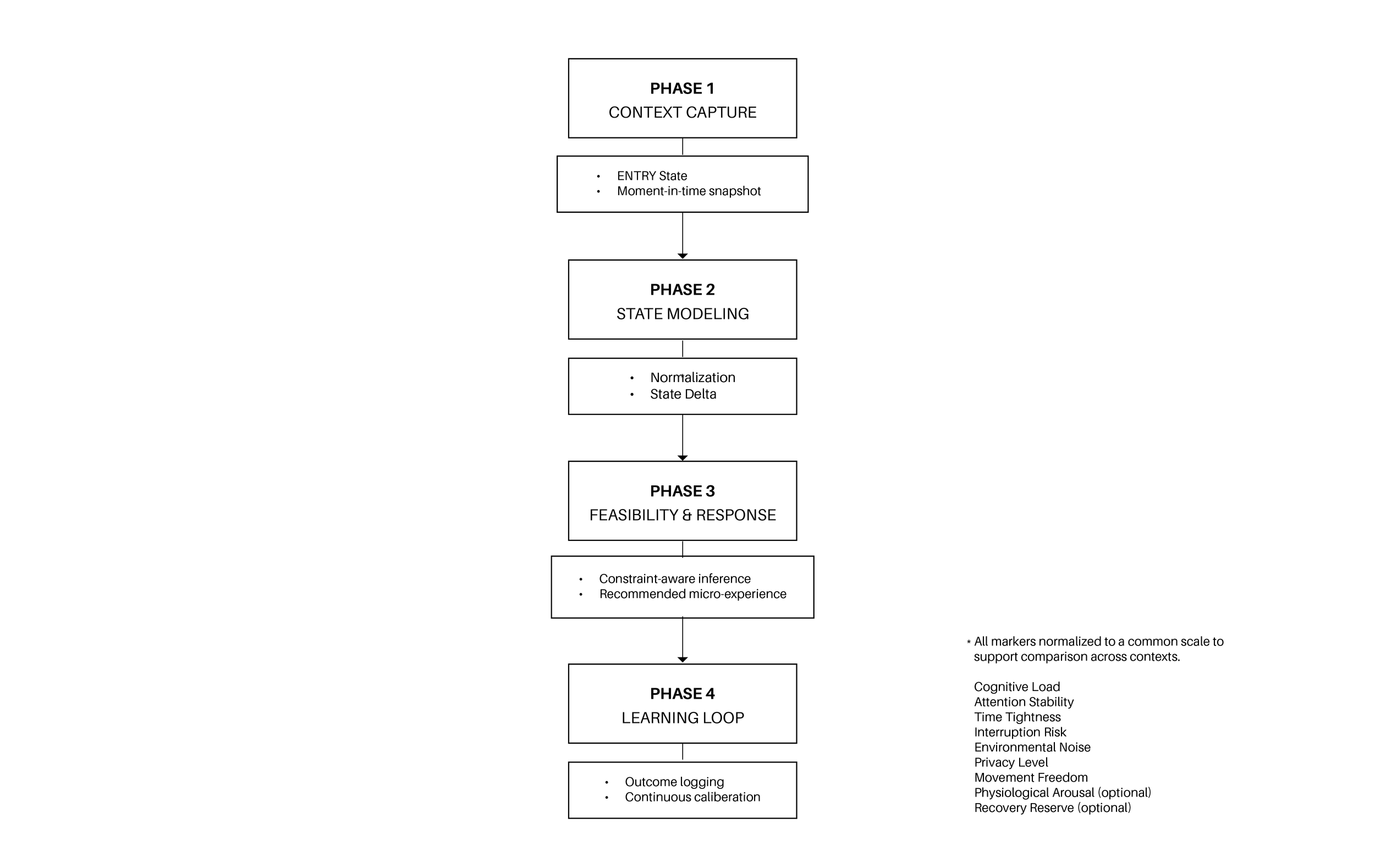
Rather than asking people to adapt to tools, VIT models the conditions that shape what is possible at a given point in time. Each interaction begins with a snapshot of the present — what the person is doing, what they intend next, and the constraints they are operating within.
This moment-in-time snapshot forms the entry state.
From there, VIT translates lived experience into normalized readiness markers — allowing signals that are otherwise fragmented to be understood together. These markers represent dimensions such as cognitive load, attention stability, time availability, environmental constraints, and physiological indicators when available.
By comparing the current state with the intended outcome, the system identifies the state delta — the direction and magnitude of change a person is attempting to make.
Crucially, this process does not assume ideal conditions. Instead, VIT evaluates feasibility in context, accounting for real-world limitations such as limited time, public environments, movement restrictions, or interruption risk.
The result is a form of constraint-aware inference: recommendations and guidance that reflect not what should work in theory, but what can work now.
Over time, observed outcomes feed back into the system, allowing readiness patterns to be refined across individuals, contexts, and use cases. This continuous calibration enables VIT to evolve as a learning framework rather than a static model.
At its core, the framework is designed to support agency — helping people and systems make informed transitions between states, without imposing uniform solutions or reducing human experience to a single signal.
VIT Framework
A Phased model for translating momentary context into adaptive micro-interventions
Shown here for conceptual orientation.THE ECOSYSTEM
Where VIT Lives and Learns
Vitality Intelligence is not developed in isolation.
It evolves through real-world engagement across multiple scales — from individual experience to institutional application.
To support this, VIT operates through a connected ecosystem of experimental and deployment pathways, each designed to observe readiness under different conditions.
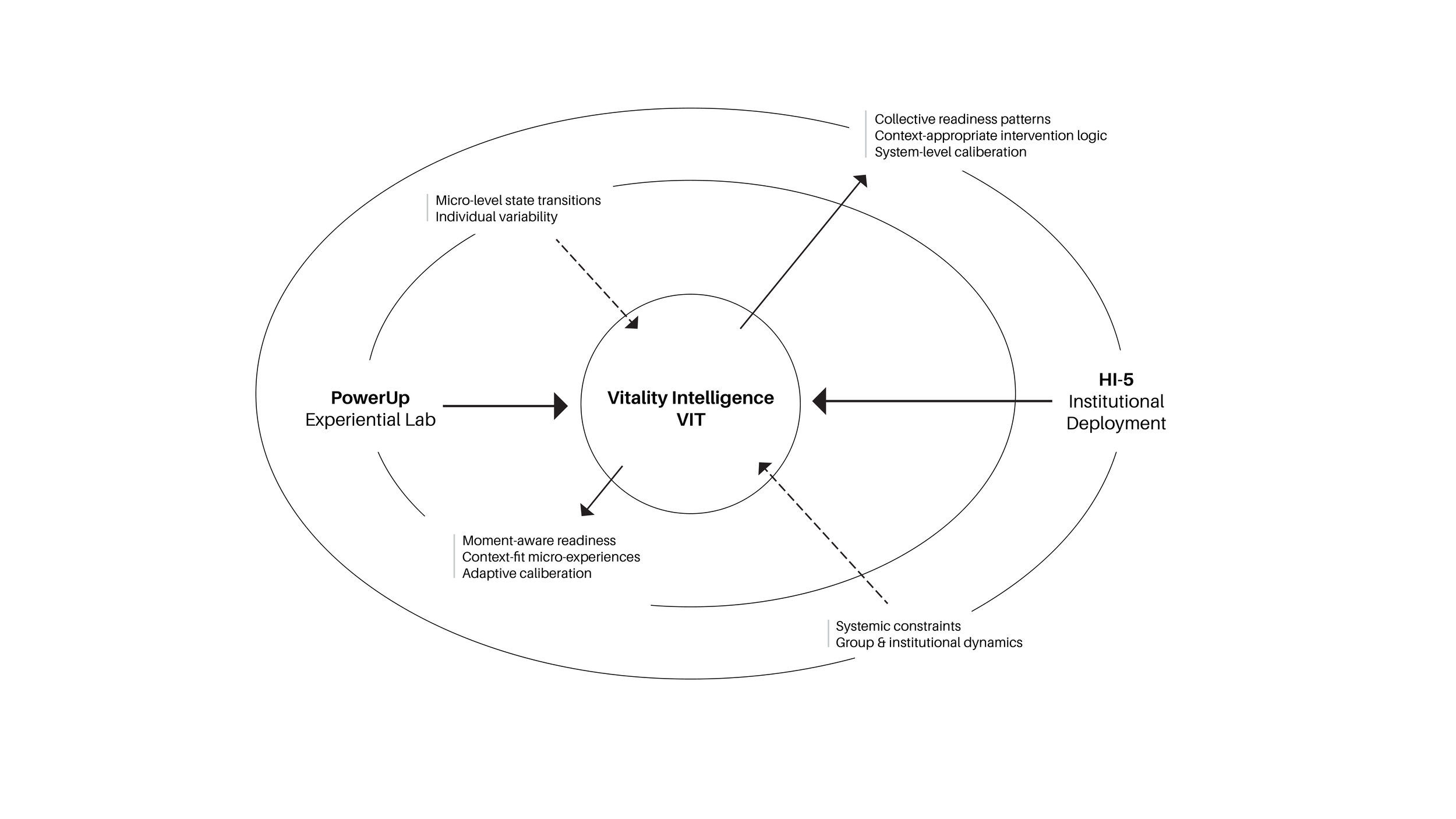
At the individual level, PowerUp functions as an experiential lab. It enables rapid testing of micro-interventions across varied moments — work transitions, cognitive fatigue, recovery periods, and preparation states. Through repeated interaction, PowerUp helps surface patterns in how people attempt to regulate attention, energy, and engagement within everyday constraints.
At the institutional level, HI-5 serves as a community and workforce deployment framework. Designed for high-responsibility environments such as first responders, municipalities, and public-serving organizations, HI-5 examines readiness at collective scale — where policy, environment, and operational reality shape human capacity.
Together, these interfaces provide complementary perspectives:
PowerUp reveals micro-level state transitions and individual variability.
HI-5 exposes systemic constraints, group dynamics, and institutional readiness patterns.
Insights from both continuously inform the core intelligence framework, allowing VIT to remain grounded in lived experience rather than abstract modeling.
This ecosystem enables VIT to function as a learning system — one that is shaped not only by theory, but by sustained interaction across diverse contexts.
VIT Ecosystem
An adaptive intelligence layer connecting individual experience and institutional systems.
Shown here for conceptual orientation.
TECHNOLOGY
From Experience to Intelligence
Vitality Intelligence translates lived experience into structured insight through a layered, signal-aware architecture.
Rather than relying on a single data source, VIT integrates multiple forms of input — including user intent, contextual constraints, interaction patterns, and optional physiological signals — to construct a coherent representation of readiness in the moment.
All inputs are normalized into comparable readiness markers. This allows heterogeneous signals — such as time availability, cognitive load, environmental limitations, or physiological indicators — to be interpreted within a shared frame, without privileging any single metric as definitive.
At the core of the system is a state-based model. Each interaction evaluates the relationship between a current condition and an intended outcome, identifying the direction and feasibility of change rather than prescribing fixed behaviors.
This approach enables constraint-aware inference — guidance that adapts to real-world conditions such as limited time, public settings, movement restrictions, or interruption risk.
Over time, outcome patterns inform continuous calibration. The system learns which forms of intervention are effective under specific combinations of context, intent, and constraint, allowing readiness modeling to become increasingly precise without requiring increased user effort.
Importantly, VIT is designed to remain human-centered by design. Physiological data, when present, functions as contextual input rather than authority. Intelligence emerges through convergence, not surveillance.
This architecture allows VIT to operate as a foundational layer — capable of informing applications, environments, and emerging experiential technologies without reducing human complexity to a single score or behavior.
COLLABORATION & RESEARCH
An Open Framework for Exploration
Vitality Intelligence is designed as a living framework — one that grows through inquiry, testing, and interdisciplinary collaboration.
The work invites engagement across domains, including design research, experiential technology, human–computer interaction, public systems, and emerging XR environments. VIT is particularly interested in contexts where human readiness matters most — moments shaped by pressure, responsibility, transition, or constrained choice.
Current and future collaborations may include:
academic research partnerships
pilot studies and field testing
institutional and community-based deployments
design and technology experimentation across physical and immersive environments
VIT approaches collaboration as a process of shared learning. Rather than prescribing outcomes, the framework is intended to support exploration — enabling researchers, practitioners, and institutions to ask better questions about how human capacity is shaped, supported, and sustained.
As experiential technologies continue to evolve, VIT seeks to contribute a human-centered intelligence layer — one that informs how systems respond to people, rather than asking people to conform to systems.
For those interested in exploring research, pilot initiatives, or collaborative inquiry, VIT welcomes conversation.
Contact Us
Interested in working together? Fill out some info and we will be in touch shortly. We can’t wait to hear from you!